
How to Tame a Fearful or Aggressive Cat: The Complete Guide to Building Real Trust
3 weeks ago
Some cats choose you immediately. You sit down, and within minutes there's a warm weight in your lap, a purring engine running at full volume, and a set of eyes closed in complete contentment. The trust was there before you even understood you'd earned it.
And then there's the other kind of experience. The cat who disappears the moment you enter the room. The one who has been in your home for three weeks and you've seen her face exactly twice. The rescue who watches you from the far corner with an expression that communicates, with complete clarity, that you are the most dangerous thing in his environment. The cat who hisses when you get within two meters. The one who has drawn blood more than once when you tried to be friendly.
If you've been through the first kind of experience, the second kind can feel bewildering and even discouraging. What is wrong with this cat? Why won't they just — settle? Why are they so difficult?
The answer, almost always, is that there's nothing wrong with the cat. There's a history that made fear make sense, and the cat hasn't yet been given sufficient reason to believe that this specific human, in this specific environment, is different from whatever came before. What looks like aggression is almost always fear wearing aggression's clothes. What looks like stubbornness is a survival mechanism that once kept the animal alive.
This guide walks through the full process of working with fearful and aggressive cats — the seven core steps that form the trust-building progression, the three advanced strategies for severe cases, the biological and psychological foundation that makes each step work, the most common mistakes that undo progress, and a realistic picture of how long this actually takes. It's patient work, but it's not mysterious work. There are reasons why these approaches succeed, and understanding those reasons makes you a more effective, more consistent advocate for the animal in your care.
Understanding the Cat in Front of You
Fear Is the Default, Not Aggression
The single most important reframe you can make when approaching a difficult cat is this: the cat who is hissing at you, who is pressing flat against a wall with their pupils dilated and their ears flattened, who lashes out when you get close — this cat is frightened. Not aggressive in the way we mean when we describe a person as aggressive. Frightened. Using the only defensive tools available to them.
This distinction matters enormously for how you respond. If you understand the cat as aggressive, you're inclined to respond with firmness, with persistence, with determination to overcome their resistance. If you understand the cat as frightened, every appropriate response changes. You back off. You reduce pressure. You look less threatening. You make yourself smaller and less dominant. You give the cat the space they're desperately communicating they need.
The behaviors we describe as aggression in cats — hissing, spitting, growling, swatting, biting — are all defensive in origin. A cat who feels completely safe never needs to use any of them. A cat who feels threatened escalates through them in a predictable sequence, each one a communication: I am uncomfortable, give me space, I mean it, last warning, I will use my claws. The cat who bites you didn't want to bite you. They wanted you to stop approaching far, far earlier, and they tried to communicate that at every step.
The Origins of Feline Fear
Cats develop their fundamental relationship with humans during a sensitive period in their neural development: roughly two to seven weeks of age. During this window, a kitten's brain is actively building its model of what is safe and what is dangerous, who is friend and who is predator, what environmental contexts are acceptable and what are threatening. This model, once built during the sensitive period, is relatively fixed. A kitten who has extensive positive contact with humans during weeks two through seven develops a model of humans as safe — and that model persists into adulthood even under stress. A kitten who has no positive human contact during this period, or who has frightening contacts, or who misses the window entirely, develops a model of humans as threatening — and that model also persists.
This is why feral cats — cats born outdoors with minimal to no human contact during the sensitive period — are typically much more difficult to socialize than undersocialized domestic kittens. The feral cat's brain built its safety model without humans in it, or with humans explicitly in the "danger" category. Taming an adult feral cat isn't training; it's asking the animal to override a deeply embedded neural model of threat. It can be done, but it takes longer and requires more patience than working with a frightened domestic cat who had some positive early experience.
Trauma and negative history add another layer. A cat who was socialized during the sensitive period but subsequently had multiple frightening or painful experiences with humans — being handled roughly, being hurt (accidentally or deliberately), being chased, being trapped or caged repeatedly without positive human interaction — can develop fear of humans despite a fundamentally positive early experience. These cats often have more variable behavior than feral cats: they can seem to relax and then suddenly become defensive, or they respond fine to one person but not another. Their model of humans is mixed, and specific triggers can reactivate the fear despite progress.
Medical pain is a frequently overlooked cause of defensive behavior that every person working with a difficult cat needs to keep in mind. A cat who is in physical pain will defend the painful area and may generalize that defense to all human contact. A cat with dental pain may resist face and head touching. A cat with joint pain may react defensively to being picked up. A cat with an internal illness may have lowered stress tolerance across the board, displaying defensive responses to handling that it tolerated easily when healthy. This is why veterinary evaluation before assuming a cat's defensiveness is purely behavioral is so important — pain-driven defensiveness doesn't improve with trust-building work; the pain needs to be addressed first.
Reading the Body Language of Fear and Aggression
Effectively working with a fearful cat requires learning to read their communication accurately. These are the signals to understand:
Low-level discomfort and warning:
- Tail held low or tucked
- Eyes wide with pupils dilated in normal lighting
- Ears rotating slightly backward
- Skin on the back rippling (piloerection)
- Breathing rate increasing
- Body held slightly tensed or crouched
Escalating fear response:
- Ears fully flattened against the skull
- Body pressed to the ground or pressed into a corner
- Tail wrapped tightly around the body
- Hissing or spitting (exhaled air through the teeth — a sound, not an attack)
- Growling
- Rolling slightly to one side (exposing claws as a defensive warning)
Imminent defensive aggression:
- Full piloerection (puffed tail, raised fur along the spine)
- Direct stare
- Tense, coiled body posture
- Growling that changes pitch
- Swatting the air in your direction without contact
Relaxation signals (progress markers):
- Slow blinking
- Ears in natural forward or slightly sideways position
- Tail in a relaxed low or loose position
- Body posture loose rather than tense
- Stretching or yawning in your presence
- Lying down with any body part not all pointing toward you as an escape route
Learning to read these signals allows you to work right at the cat's threshold — close enough to provide positive association, far enough to stay below the defensive response — and to immediately recognize when you've pushed too far and need to back off.
- Fear Is the Default, Not Aggression
- The Origins of Feline Fear
- Reading the Body Language of Fear and Aggression
- 1. How long does it take to tame a fearful cat?
- 2. Why is my cat afraid of people?
- 3. Is aggression always caused by fear?
- 4. Should I chase my cat to make them socialize?
- 5. Why should I let the cat make the first move?
- 6. Why does my cat keep hiding?
- 7. What makes a good safe space for a scared cat?
- 8. Can food help tame a cat?
- 9. What type of food works best for trust training?
- 10. Should I hand-feed a frightened cat?
- 11. Why should I speak softly to my cat?
- 12. Is it okay to pick up a scared cat?
- 13. When can I start petting my cat?
- 14. Where do most cats enjoy being petted?
- 15. Why is play important when taming a cat?
- 16. Which toys work best?
- 17. Can play reduce aggression?
- 18. What should I do if my cat hisses?
- 19. Should I punish an aggressive cat?
- 20. What body language shows my cat is becoming comfortable?
- 21. What are synthetic feline pheromones?
- 22. Can pheromone diffusers calm fearful cats?
- 23. Should I force my cat out of hiding?
- 24. When should I seek veterinary advice?
- 25. Can pain cause aggression?
- 26. Can rescued cats become affectionate?
- 27. How important is consistency?
- 28. What mistakes should I avoid?
- 29. Can children help tame a fearful cat?
- 30. What is the key to successfully taming a fearful cat?
The Seven Core Steps
Step One: Let the Cat Initiate Contact
This step is the foundation of everything that follows, and it's the one that most impatient people find hardest: you stop trying to approach the cat and instead make yourself available for the cat to approach you on their terms.
The logical flaw in trying to approach a fearful cat is that every time you close distance, you're demonstrating exactly what the cat fears about you — that you override their signals and invade their space. Even if you're being gentle, the approach itself confirms the cat's model of humans as entities that don't respect their boundaries. Every successful defensive response (you backed off when they hissed or ran) reinforces that the defensive behavior works, which makes the behavior more likely in the future.
The alternative is to make yourself available without applying any pressure. Sit on the floor — floor level is important, as it makes you smaller and less physically dominant. Don't look directly at the cat, because direct eye contact from a predator-sized animal is threatening to most cats. Read a book, use your phone, do something that makes your presence feel normal and unthreatening rather than focused on them. Let the session last as long as is practical — twenty minutes, thirty minutes, longer if you can. And leave before any defensive response is triggered.
What you're doing is adding data points to the cat's experience: human was present, human was boring, nothing bad happened. Enough of these data points, accumulated without any frightening events mixed in, gradually shifts the cat's model toward "human = neutral" which is the essential first step before "human = good."
Curiosity in cats is a strong drive, and it generally overcomes fear when the perceived threat level is low enough. A cat who has been observing you from a distance without anything bad happening for several sessions will often begin to drift closer — not because they've decided to trust you, but because their curiosity about this stationary, non-threatening thing outweighs their residual caution. That voluntary approach, however tentative, is significant: the cat is making a choice to close distance, rather than having distance closed by you. Every voluntary approach reinforces the cat's sense of agency and control.
What to avoid absolutely in this phase: chasing the cat, cornering the cat, reaching toward the cat, making sudden movements or loud sounds, making direct eye contact, leaning toward the cat. Any of these instantly restore the threat model and can set back days of progress.
Step Two: Create a Dedicated Safe Zone
The fearful cat's primary need is a place where they know, with certainty, that they will not be approached or disturbed. This safe zone is not a luxury — it's the emotional foundation from which all trust-building proceeds. A cat who has no guaranteed refuge will remain in a state of constant vigilance that prevents any relaxation or openness to positive experience.
The safe zone should have specific characteristics: physical enclosure that provides the sense of concealment (an open-top container in which the cat can see out but feels semi-hidden is less effective than a covered box with a small entrance hole, which allows the cat to control their exposure); a consistent location that doesn't change; low foot traffic in the surrounding area; the cat's scent established in it (a blanket or bedding that carries their scent, ideally something that's been in contact with their sleeping area); and a clear guarantee — enforced through household rules if there are other people or pets — that no one will reach into it or disturb the cat when they're inside.
Ideally, the cat also has clear escape routes from any interaction space to the safe zone. A cat who can see the path to their refuge feels less trapped than one who can't, and a cat who feels less trapped is less likely to escalate to defensive aggression. The escape route itself reduces the need to use it.
For severe cases — extreme trauma, feral cats being introduced indoors — limiting the initial available space to a single room rather than the entire home reduces overwhelm and makes the cat's territory manageable. A single room with all necessary resources (food, water, litter, safe zone) allows the cat to map and establish comfort in a contained space before the available territory expands.
Step Three: Use Food as a Bridge
Food is the most reliable bridge to a fearful cat's cooperation because it creates a physiological positive experience — the pleasure of eating something appealing — that the cat's nervous system cannot help responding to even when fear is elevated. You are working with the animal's biology rather than against their psychology.
The technique is classical conditioning: pairing your presence with food until your presence becomes a predictor of something positive. Begin by placing food at whatever distance the cat can comfortably eat without showing stress — this might be across the room, it might be in a separate area. The goal isn't for you to be close; it's for the food to appear when you're present.
Over multiple sessions, very gradually — millimeters to a centimeter at a time over days, not rushing — reduce the distance between where you are and where the food is. The cat will tell you when you've moved too fast: they'll show stress signals or leave before eating. When this happens, move the food back to a comfortable distance and slow the progression.
Eventually you can work toward placing food near your feet, then placing it in your hand held flat on the floor (less threatening than food held up), then to food offered by a hand at the cat's level. Each of these is a milestone that might take days or weeks depending on the individual cat's history and temperament.
The choice of food matters here. The most palatable, highest-value food you have available — not the regular diet if the cat is indifferent to it, but something genuinely exciting for that individual cat. Tuna, small pieces of cooked chicken, commercially available cat treats with intense smell, a particularly appealing wet food with a strong aroma — the stronger the positive response to the food, the stronger the positive association with your presence that builds.
An important principle about feeding proximity: only offer food in contexts that require the cat to choose to come closer to you. If you place food across the room and walk away, you've removed the conditioning variable — the food is associated with an empty space, not with you. The conditioning works when the food's presence and your presence are simultaneous.
Step Four: Speak in Soft, Calm Tones
This step is both simpler than it sounds and more impactful than most people expect. Cats have hearing that extends into frequencies well above human vocal range, and they are acutely sensitive to the pitch, rhythm, and emotional quality of vocalizations. A voice that rises in pitch (as anxious or excited voices do) signals activation to a cat. A voice that drops in pitch and slows in rhythm (as calm, confident voices do) signals the absence of threat.
When you're near a fearful cat, speak softly and slowly. The content barely matters — you can narrate what you're doing, describe your day, talk about anything. What matters is the acoustic profile: low pitch, slow rhythm, even tone, no sudden volume changes. Think of it as the vocal equivalent of slow-blinking — a non-verbal communication channel telling the cat that you are calm and therefore they can be too.
Avoid high-pitched sounds even when they're positive sounds — many people instinctively raise their pitch when excited by a cat showing progress ("OH, you came so close!") and this excitement communicates itself to the cat as activation that can trigger a retreat. Maintaining low, calm tones even when things are going well is counterintuitive but important.
Silence is often better than speech in the very early phases. A completely quiet presence is neutral; an active voice is a stimulus that needs to be habituated to. As the cat becomes more comfortable with your quiet presence, introducing speech gradually gives them something to habituate to at a manageable pace.
Step Five: Never Force Physical Contact
This step is the most commonly violated, even by people who know they're violating it, because the temptation is strong. The cat is right there. They're not running. You want to show them that being touched is fine. How will they ever learn if they're never touched?
The answer is: they will learn, but the timeline is set by the cat's readiness and not by your impatience. And forcing contact before that readiness is established doesn't speed the process — it reverses it. Every instance of forced contact confirms the cat's model of humans as entities that override their signals and violate their space. The cost is real, and it can be days or weeks of trust-building undone in a single moment.
The operating rule is always: the cat initiates contact or the cat doesn't get contact. This means that when the cat finally approaches close enough for touching to be possible, you wait. You don't reach toward them. You let their movement — their nose touching your hand, their face pushing into your extended fingers, their body rubbing against your leg — be the contact. They're deciding. They're choosing to make contact with you. That choosing is what builds trust. You receiving the contact they initiate, without trying to extend or escalate it, teaches them that they control the interaction.
This is frustrating. There will be moments when the cat is right next to you and you will want so badly to pet them. Don't. Extend a finger at their nose level. Let them sniff. If they choose to rub their cheek against the finger — wonderful, let that happen. Don't follow the rub with a stroke. Let them back away and return if they want. Let it be their choice, every time, until their choice becomes reliably to seek contact rather than avoid it.
Step Six: Build Connection Through Play
Play serves a trust-building function that's distinct from but complementary to food-based conditioning. Where food creates a physiological reward association, play creates a shared behavioral experience — you and the cat doing something together, with you as the source of one of the things the cat is most hardwired to enjoy.
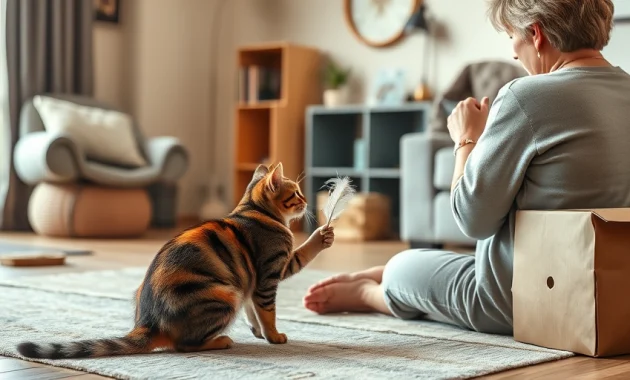
Wand toys are the ideal tool for this phase because they allow meaningful interaction across distance. A wand with a feather or fabric attachment can stimulate genuine predatory play from several feet away — the cat can be fully engaged in play while still maintaining a distance that feels safe to them. As the trust deepens, that distance naturally closes: the cat, following the toy in predatory focus, will come closer to you than they would in any non-play context.
The prey-like movement quality of the toy matters enormously. Dragging a wand toy in a straight line across the floor produces less engagement than simulating genuine prey movement: erratic direction changes, sudden pauses and bursts of speed, ducking behind furniture edges and emerging unpredictably, the slow ground-level creep of a lizard alternating with the flutter of a bird. Prey that behaves like prey triggers predatory behavior; prey that moves like a pulled string often doesn't.
Watch for the moment in play where the cat's posture shifts from cautious to fully predatorily engaged — ears forward, pupils dilated with excitement rather than fear, body in the hunting crouch, tail moving slowly at the tip, entire focus on the toy with no residual focus on you as a threat. This moment is significant: the cat's fear center has been overridden by predatory drive, and they're experiencing you as the source of genuine positive engagement rather than as a threat. These moments of shared play are when some of the deepest trust shifts happen.
After play sessions that go well — particularly ones where the cat has come closer than usual or showed more relaxed behavior than usual — place a treat where the cat can easily find it. This layers food-positive association onto the play-positive association, creating a cumulative positive relationship with your presence.
Step Seven: Introduce Gentle Touch in the Right Locations
When the cat has progressed to the point where they're voluntarily coming within touching distance, sniffing your hand without retreating, and perhaps pressing their face against your extended finger — you're approaching the moment where touch becomes possible. The location of first touch matters enormously.
Cats have concentrated scent glands along specific facial areas: the cheeks (around the whisker pads and below the eyes), the chin, the forehead, and the base of the ears. These are the areas where cats rub their faces against objects and other cats to deposit their scent — a marking behavior associated with positive emotional states and social bonding. When you touch these areas, you're touching areas the cat already has positive associations with from their own rubbing behavior.
Extend a single finger or knuckle at the cat's nose level, slightly in front of and below their face. Let them touch it with their nose. If they follow the sniff by pushing their cheek or chin forward into contact with your finger — this is the cat asking to be petted in that location. Extremely gently, with very light pressure, allow the contact to happen for two or three seconds. Stop before the cat shows any sign of wanting to stop. Let them move away. Let them choose to return.
The areas to avoid in early touch: the belly, the lower back and base of the tail, the legs, the paws, and the top of the head approached from above. These are areas many cats find threatening or overstimulating to have touched by an unfamiliar person, for various reasons: the belly is physically vulnerable; the lower back activates a sensitivity that can produce defensive responses in some cats; the legs and paws are associated with being restrained; the head approached from above replicates what a predator does. Face level and face areas are the safe starting point.
Keep early touch sessions extremely brief — a few seconds of contact is enough and is better than a minute that ends with the cat wanting to leave. End on a positive note (the cat still engaged, not showing discomfort) rather than waiting until the cat retreats. The neural learning that's occurring is: contact happened, it was fine, I chose to end it and leave. That's the model you want to build.
Advanced Strategies for Severely Fearful Cats
For Cats Who Were Feral or Severely Traumatized
Everything in the seven steps above applies, but the timeline extends substantially and the threshold for "too much pressure" is lower. A cat who spent the first year of life as a feral outdoor cat, or who experienced significant human-induced trauma, may take months to reach the point that a merely undersocialized domestic cat reaches in weeks.
For these cats, the most important thing you can do is not give up the approach when progress is slower than you hoped, not interpret slow progress as evidence that the cat can never be tamed, and not mistake temporary regression — which happens regularly with fearful cats when something triggers a fear spike — as the loss of all progress made.
Extended patience with the passive presence phase: For a severely fearful cat, the "sit in the same room and be boring" phase may need to continue for weeks before any significant voluntary approach happens. This isn't failure; it's the cat's brain doing the work of establishing that the threat level is consistently low enough to begin reducing vigilance. Rushing it shortens the apparent time by forcing interactions, but those interactions set back the actual trust development.
Room-by-room territorial expansion: When a severely fearful cat has been established in a single room and shows consistent comfort signals in that room, expanding access to an adjacent room or area should be gradual and at the cat's pace. Forcing a fearful cat into a larger unfamiliar space before they're ready is experienced as a significant stressor, not a positive development.
Synthetic Pheromone Diffusers
Feliway and similar synthetic pheromone products that mimic the feline facial pheromone cats deposit when they rub their cheeks on surfaces they consider safe have a reasonable evidence base for reducing anxiety-related behaviors in cats. They don't work dramatically on all cats, but they don't cause harm, and for some cats they provide a meaningful reduction in baseline anxiety that makes the other trust-building work easier.
The mechanism is interesting: the synthetic pheromone, detected by the cat's vomeronasal organ, activates neural pathways associated with familiarity and safety — the same pathways activated when the cat themselves rubs their face on a safe object. It's creating a low-level background signal of "this environment is familiar and safe" that may slightly reduce the arousal level that makes fear responses more likely.
For a severely anxious cat in a new environment, running a diffuser in the room they're initially confined to is worth trying as part of the overall approach, with realistic expectations: it may help noticeably, it may help marginally, or it may not produce obvious change, but it carries no downside.
When to Involve a Veterinarian or Behaviorist
There are specific situations where the trust-building work described here won't produce sufficient improvement alone:
Persistent aggression despite weeks of appropriate approach: If a cat has been exposed to consistent, patient, non-pressure interaction for six to eight weeks and shows no change in defensive behavior — still hissing and fleeing at every approach, still displaying full threat posture rather than beginning to habituate — there may be a medical component driving the defensiveness. Chronic pain, hyperthyroidism (which elevates anxiety and reactivity), neurological conditions, and other medical issues can produce defensiveness that doesn't respond to behavioral approaches because the underlying cause isn't behavioral.
Sudden onset of aggression in a previously friendly cat: A cat who was friendly or at least manageable who suddenly becomes defensive and aggressive is showing a behavioral change that warrants medical evaluation before anything else. Sudden behavioral shifts in adult cats — particularly changes toward defensiveness or aggression — more often indicate a medical cause than a behavioral one. Pain is the most common culprit.
Aggression that produces injuries to people or other animals: A veterinary behaviorist consultation is appropriate when the safety of household members or other pets is being genuinely compromised. Veterinary behaviorists can assess whether pharmaceutical support — anti-anxiety medications, SSRIs, or other agents — might reduce the cat's baseline anxiety enough to make behavioral modification possible, and can design a specific protocol for the individual case.
Common Mistakes That Undo Progress
Moving Too Fast Because of Small Successes
Progress with a fearful cat can feel intoxicating when it happens. The cat came an inch closer than they did yesterday. They sniffed your hand for the first time. They ate the treat you placed near your foot. The temptation after these breakthroughs is to push further immediately — to extend the hand that just got sniffed, to try to touch when the treat eating is done, to see if you can go even further now that the barrier broke.
Resist this completely. Small progress is fragile progress, and it can disappear instantly if the cat is pushed past what they were ready for. The approach that works is: celebrate small wins internally, make nothing happen to mark them externally, and maintain exactly the same patient, non-pressuring approach. The breakthrough will consolidate if you let it. If you push it, it won't.
Inconsistency Between Household Members
The trust-building process requires consistency, and consistency is undermined if different people in the household use different approaches with the cat. If you're being patient and non-pressuring while someone else is chasing the cat or trying to pick them up against their will, the cat's experience is mixed: this person is safe, that person is dangerous, and the environment as a whole cannot be predicted. The trust development stalls or doesn't happen.
Establishing shared household rules about the fearful cat — no chasing, no forcing contact, the safe zone is guaranteed, who feeds the cat and how, who does play sessions — and ensuring everyone consistently applies them is essential. This is particularly important with children, who often can't resist trying to interact with a cat and may need repeated, patient explanation of why the rules matter for the cat's wellbeing.
Punishment for Defensive Behavior
Some people, encountering a hissing or swatting cat, respond with spray bottles, sharp sounds, physical correction, or any other punishing stimulus. This is counterproductive on every level. The cat is hissing because they're frightened. A painful or frightening stimulus delivered in response to hissing doesn't teach the cat not to hiss — it confirms that this human is frightening and validates the entire defensive behavioral posture.
The appropriate response to defensive behavior from a fearful cat is always to reduce pressure: back off, lower yourself, break eye contact, move more slowly, give more space. You're not rewarding the hissing by backing off — you're communicating that you can read their signals and you respect them. That communication is what builds trust.
Giving Up After Regression
Fearful cats regress. Something frightening happens — a loud noise, a visitor who broke the rules and chased them, a medical procedure — and behavior that had improved significantly goes back to where it was weeks ago. This is genuinely discouraging, and many people interpret it as evidence that all the work was wasted or that this particular cat can't be tamed.
Regression is part of the process with fearful cats. The neural pathways built during the trust-building work aren't erased by a regression event — they're there, just temporarily superseded by the reactivated fear pathways. Recovery from a regression typically happens faster than the original trust-building did, because the cat's brain has already done the work of building those positive associations once.
Realistic Expectations and Milestones
The Timeline Honestly
A mildly undersocialized domestic cat who had some positive human contact during the sensitive period may become comfortable with basic handling in two to four weeks of consistent, patient work. A seriously undersocialized domestic cat who had minimal positive human contact may take two to four months. An adult feral cat being brought indoors for the first time may take six months to a year or more to reach genuine comfort with human contact, and some will never become fully comfortable with being handled even if they eventually tolerate limited contact.
Within those ranges, individual variation is enormous. Temperament, age, health status, the quality and consistency of the approach being used, the household environment, and simply individual neural variation all affect timeline. Progress is also non-linear — periods of apparent stalling, or regression, are interspersed with genuine breakthroughs. A journal of specific behavioral observations can help you see progress that's invisible day-to-day but visible across weeks.
Milestones Worth Celebrating
First voluntary approach: The first time the cat moves toward you rather than away is a milestone. Even if it's a tentative two steps before retreating, that's significant data.
First eating near your presence: When the cat eats food without showing stress signals while you're at whatever distance has been established, the food-presence association is beginning.
First slow blink: When a cat slow-blinks at you — the deliberate, unhurried closing and opening of the eyes — they're using the feline language of safety and trust. Slow-blinking back establishes a communication channel.
First voluntary touch: When the cat rubs their cheek or chin against your hand for the first time, they're not just accepting contact — they're initiating a scent-marking behavior that says "this is part of my safe world."
First relaxed body posture in your presence: When the cat lies down, stretches, yawns, or grooms themselves while you're present, their stress system has relaxed enough to permit behaviors that only happen when an animal feels safe. This is one of the most meaningful signs of genuine progress.
Conclusion: The Relationship You Build Is Worth the Time It Takes
There's a quality to the relationship with a cat who chose to trust you — who had every reason not to, whose history gave them reason to be afraid of humans, who made the internal journey from fear to comfort to something that looks, unmistakably, like affection — that's different from the relationship with a cat who was simply always friendly. There's a depth to it. A weight.
The cat who trusts you when trust was hard to earn is telling you something real. They're telling you that the patience you offered registered. That the boundaries you respected were noticed. That the consistency of your approach across weeks and months built something in their nervous system that looks like safety when they see your face, that looks like home when you're in the room.
This is worth the time. It's worth the patience in the early weeks when nothing seems to be happening. It's worth the consistency when the rules of no-forcing and slow-approach feel arbitrary and frustrating. It's worth waiting for the cat to choose you instead of trying to force the choice.
The cat will choose you, in time, if you give them reason to. And the relationship that results from that choosing is one of the more genuine things available in a life shared with animals.
FAQ
1. How long does it take to tame a fearful cat?
Every cat is different. Some cats begin trusting people within a few days, while others—especially rescues or traumatized cats—may need several weeks or even months of patient, consistent interaction.
2. Why is my cat afraid of people?
Fearful behavior often develops because of:
- Lack of early socialization
- Previous abuse or neglect
- Traumatic experiences
- Sudden environmental changes
- Limited positive interactions with humans
3. Is aggression always caused by fear?
Not always, but fear is one of the most common causes. Aggression may also result from pain, illness, territorial behavior, or overstimulation, which is why veterinary evaluation is important if aggression appears suddenly.
No. Chasing a fearful cat reinforces the idea that you are a threat. Always allow the cat to approach you voluntarily.
5. Why should I let the cat make the first move?
Allowing the cat to initiate contact helps them feel safe and in control, which is essential for building long-term trust.
6. Why does my cat keep hiding?
Hiding is a natural coping mechanism for frightened cats. A secure hiding place reduces stress and helps them gradually gain confidence.
7. What makes a good safe space for a scared cat?
A quiet, low-traffic area with:
- A covered cat bed
- A cardboard box
- A carrier left open
- Food and water nearby
- A clean litter box
8. Can food help tame a cat?
Yes. High-value treats and meals create positive associations with your presence, making food one of the most effective trust-building tools.
9. What type of food works best for trust training?
Highly palatable treats or premium cat food often work best because they provide a stronger reward than regular meals.
10. Should I hand-feed a frightened cat?
Only if the cat is comfortable approaching you. Otherwise, place the food nearby and gradually decrease the distance over time.
11. Why should I speak softly to my cat?
Cats have highly sensitive hearing. Calm, gentle voices communicate safety, while loud voices may increase fear and anxiety.
12. Is it okay to pick up a scared cat?
No. Picking up or restraining a frightened cat usually increases stress and may lead to scratching or biting.
13. When can I start petting my cat?
Begin only after the cat voluntarily approaches, sniffs your hand, or rubs against you.
14. Where do most cats enjoy being petted?
Many cats prefer gentle strokes on:
- The cheeks
- Under the chin
- The forehead
- Behind the ears
- The base of the neck
15. Why is play important when taming a cat?
Interactive play builds confidence, reduces stress, and helps the cat associate you with enjoyable experiences.
16. Which toys work best?
Popular choices include:
- Wand toys
- Feather teasers
- Fishing-rod toys
- Rolling balls
- Interactive puzzle toys
17. Can play reduce aggression?
Yes. Play provides a healthy outlet for hunting instincts and excess energy, which can reduce frustration-related aggression.
18. What should I do if my cat hisses?
Remain calm and give the cat space. Hissing is a warning signal indicating discomfort or fear.
19. Should I punish an aggressive cat?
No. Punishment increases fear and damages trust. Reward calm behavior instead of reacting harshly.
20. What body language shows my cat is becoming comfortable?
Positive signs include:
- Slow blinking
- Relaxed posture
- Upright tail
- Rubbing against you
- Kneading
- Purring
- Approaching voluntarily
21. What are synthetic feline pheromones?
Synthetic pheromone diffusers mimic calming facial pheromones produced by cats and may help reduce stress in some individuals.
22. Can pheromone diffusers calm fearful cats?
Many cats benefit from pheromone diffusers, although results vary between individuals. They work best alongside behavioral training rather than as a standalone solution.
23. Should I force my cat out of hiding?
No. Allow the cat to leave their hiding place on their own. Forced interaction often delays the trust-building process.
24. When should I seek veterinary advice?
Schedule a veterinary examination if your cat:
- Suddenly becomes aggressive
- Shows signs of pain
- Stops eating
- Has behavioral changes that persist for several weeks
- Injures people or other pets
25. Can pain cause aggression?
Yes. Dental disease, arthritis, injuries, urinary problems, and other painful conditions frequently cause defensive aggression.
26. Can rescued cats become affectionate?
Absolutely. With patience, consistency, and positive experiences, many rescued cats develop deep, trusting bonds with their caregivers.
27. How important is consistency?
Consistency is one of the most important factors in taming a fearful cat. Predictable routines help build confidence and reduce anxiety.
28. What mistakes should I avoid?
Avoid:
- Chasing the cat
- Cornering them
- Forcing cuddles
- Yelling
- Punishing fearful behavior
- Making sudden movements
- Invading their safe space
29. Can children help tame a fearful cat?
Yes, but only under adult supervision. Children should be taught to remain calm, quiet, and respectful of the cat's boundaries.
30. What is the key to successfully taming a fearful cat?
Patience, gentle handling, positive reinforcement, interactive play, respect for personal space, and allowing the cat to progress at their own pace are the foundations of building lasting trust.