
iQOO 16 Leaked Again: 200MP Camera, 2K Display, 2nm Chip? Price Set to Skyrocket!
1 month ago · Updated 1 month ago
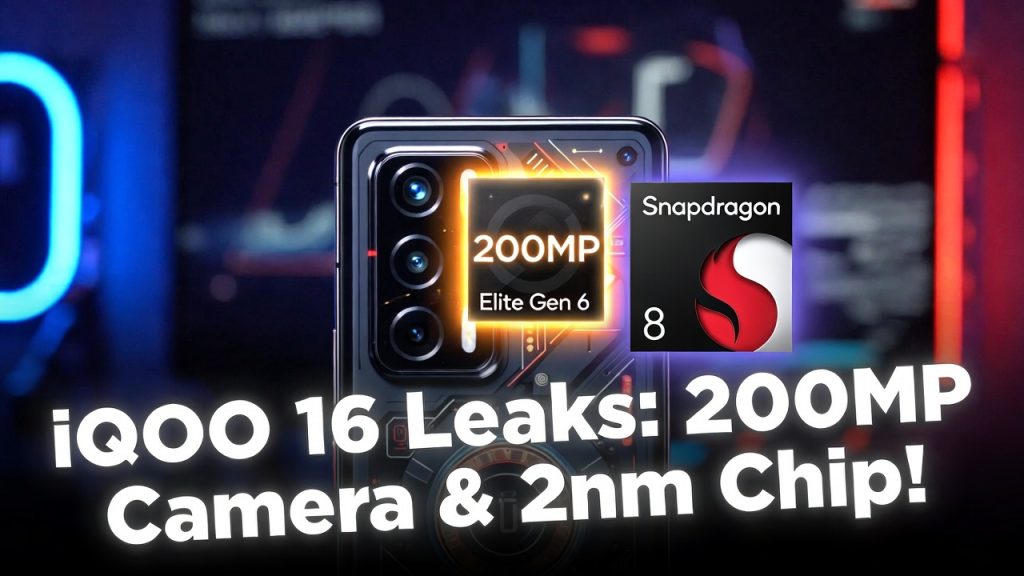
The world of gaming smartphones just got a whole lot more exciting. iQOO, Vivo's sub-brand long recognized as a serious player in the flagship gaming segment, appears to be preparing its next generation with extraordinary ambition. The iQOO 16, expected to be one of the most anticipated gaming flagships of late 2025, has begun revealing itself through a series of tantalizing leaks that have sent the smartphone enthusiast community into a frenzy.
The latest information comes from Smart Pikachu, a well-known and widely trusted technology leaker who is active on Weibo China's dominant microblogging platform and historically the first place where leaked hardware details surface for Chinese smartphone brands. The report was subsequently picked up and published by Gizmochina, one of the most closely followed sites covering Chinese technology and consumer electronics, on Sunday, March 9, 2025.
What makes this particular set of leaks extraordinary is not just the individual specification numbers, impressive as they are. It is what those numbers collectively reveal about iQOO's strategic direction: a bold and deliberate pivot from being primarily a high-performance gaming phone that also happens to have decent cameras, to a device that is prepared to compete head-on with the very best camera flagships on the market. That is a dramatic statement of intent.
This article presents a comprehensive analysis of every dimension of the iQOO 16 leaks from the dramatic camera resolution jump and display quality upgrade, to the potentially revolutionary chipset, the battery and charging expectations, the pricing implications, and the competitive positioning in an increasingly crowded flagship gaming market. Since all of this information is still unconfirmed by iQOO or Vivo officially, it must be treated with appropriate skepticism, but the source's track record warrants serious attention.
"Gaming phone fans, get ready! Rumors about the iQOO 15 successor are heating up. The latest leaks reveal that the iQOO 16 is likely to receive a massive upgrade in its main camera." — Nesabamedia, March 9, 2025
Who Is iQOO? The Gaming Brand That Keeps Exceeding Expectations
Before diving into the details of the leaks, it is essential to understand who iQOO is and why every piece of information about its upcoming products generates the level of attention it does. iQOO (pronounced "I-Q-O-O" or simply "iqoo") is a sub-brand of Vivo, a Chinese electronics company that is also part of BBK Electronics the conglomerate that also owns OPPO, OnePlus, Realme, and several other major brands. Despite sharing corporate parentage with these brands, iQOO operates with significant independence in terms of product design, marketing, and target audience.
iQOO's Origins and Mission
iQOO was launched in March 2019 with a clearly defined purpose: to create a brand entirely dedicated to users who demand maximum performance without compromise. The name iQOO is an acronym for "I Quest On and On" a manifesto that reflects the competitive spirit and relentless pursuit of excellence that defines the brand's identity. From the very beginning, iQOO products were designed for users who push their devices to the limit: gamers, power users, content creators, and technology enthusiasts who want the best hardware available.
In a relatively short time, iQOO built a solid reputation in the flagship gaming segment. The iQOO Pro, iQOO Neo, and the main iQOO numbered series have consistently delivered combinations of the fastest processors, ultra-fast charging, gaming-grade displays, and sophisticated cooling systems all in packages that are often priced more competitively than rivals with comparable specifications. This value-for-money proposition has been a cornerstone of iQOO's appeal.
iQOO's Position in the Global Market
Although rooted in China and initially available only in the domestic market, iQOO has expanded its footprint into international markets, with India becoming one of its most important markets outside of China. In India, iQOO has successfully positioned itself as a serious alternative to Samsung, OnePlus, and Xiaomi in the upper-middle and flagship price segments, regularly winning benchmark comparisons and review awards.
The success of iQOO internationally is largely driven by its aggressive pricing strategy: consistently delivering specifications that match or exceed competitors at lower price points. The iQOO 15, for example, offered the latest Snapdragon 8 Elite chipset, a 1.5K AMOLED display with 144Hz refresh rate, and 120W fast charging all in a package starting at 4,199 Chinese Yuan (approximately $580 USD or around 10.3 million Indonesian Rupiah) in China. For context, devices with comparable specifications from Samsung or Apple typically cost significantly more.

Figure 2: The iQOO lineup evolution showing the brand's progression from a pure gaming phone to an increasingly versatile all-rounder flagship. The iQOO 15 (the direct predecessor of the iQOO 16) serves as the critical benchmark for understanding just how significant a leap the iQOO 16 leaks are promising — particularly in the camera department, which has historically not been iQOO's primary competitive strength. (Credit: iQOO / Vivo)
The iQOO 15: Setting the Baseline
To fully appreciate what the iQOO 16 leaks are promising, it is important to understand where the iQOO 15 sits. Launched with Qualcomm's Snapdragon 8 Elite the flagship chipset of late 2024 the iQOO 15 delivered exceptional gaming performance, with AnTuTu scores that placed it among the fastest Android devices globally at launch. Its 1.5K AMOLED display offered a balance between resolution quality and power efficiency that most users found satisfying.
However, the iQOO 15's camera system a 50MP main camera plus a 50MP periscope telephoto was generally regarded as competitive but not best-in-class. Reviews consistently noted that while the hardware was capable, the camera software processing and the overall photography experience did not quite match what the best camera phones from Samsung and Xiaomi offered in the same price range. The iQOO 16 leaks suggest this is precisely the area where the brand is determined to make its boldest statement yet.
The Camera Leap: From 50MP to 200MP — Revolution or Marketing?
The single most jaw-dropping element of Smart Pikachu's leak is the reported upgrade in the main camera from 50 megapixels in the iQOO 15 to 200 megapixels in the iQOO 16. This is not an incremental improvement — it is a four-fold increase in pixel count that, if implemented well, has the potential to transform iQOO's position from "gaming phone with decent cameras" to "gaming phone that also competes seriously in flagship photography."
What Does 200MP Actually Mean in Practice?
The number 200 megapixels sounds extraordinary, but understanding what it means in everyday use is important for setting realistic expectations. A 200MP sensor in a smartphone does not typically shoot in full 200MP resolution by default, because the resulting file sizes — which can reach 50-80MB per photograph — are impractical for most use cases. Instead, 200MP sensors in smartphones are typically used in several different modes that serve different purposes.
The first mode is full-resolution capture: shooting at the complete 200MP resolution for situations where maximum detail is required — for example, when photographing architecture, landscapes, or detailed subjects that will be heavily cropped or printed at large formats. The second and more commonly used mode is pixel binning, a technique where multiple physical pixels are combined into a single larger "virtual" pixel. With 4-in-1 binning, a 200MP sensor produces 50MP output images with larger virtual pixel sizes, dramatically improving low-light performance by capturing more light per virtual pixel. With 16-in-1 binning, the same sensor produces 12.5MP images with even larger virtual pixels, achieving the best possible low-light performance.
The third significant advantage of a high-resolution sensor is what might be called "resolution-based optical zoom." When shooting at 200MP, digitally cropping to 50% of the frame still yields a 50MP image — equivalent to the main camera resolution of many flagship smartphones. This provides dramatically better digital zoom quality than lower-resolution sensors, making it possible to "reach in" and crop aggressively without significant quality loss.
The 200MP Smartphone Landscape
iQOO would not be the first brand to use a 200MP sensor in a smartphone if the leak proves accurate. The 200MP era in mobile photography began in earnest with the Xiaomi 12T Pro in late 2022, using the Samsung ISOCELL HP1 sensor. The most prominent current implementations are the Samsung Galaxy S23 Ultra and S24 Ultra, both using Samsung's own ISOCELL HP2 200MP sensor, and which are widely regarded as the benchmark for what 200MP camera systems can achieve.
Several other manufacturers including Motorola, Tecno, and Infinix have also shipped 200MP devices, typically using the same Samsung ISOCELL HP series sensors. The key insight from the evolution of 200MP smartphones is that the pixel count alone does not determine photo quality — the camera's image signal processor (ISP), the quality of the optical lens, and the software processing algorithms are equally or more important.
The Samsung Galaxy S24 Ultra's camera excellence, for example, is not simply a function of its 200MP sensor. It is the combination of that sensor with Qualcomm's Snapdragon 8 Gen 3 ISP, Samsung's proprietary Galaxy AI image processing, ProVisual Engine tuning, and years of color science development that makes it a consistently excellent camera. For iQOO to replicate or surpass this level of camera performance, it would need not just a great sensor but a complete camera system — hardware, software, and AI processing — of comparable quality.
🔭 LEAK — Unconfirmed: The 200MP sensor most likely to be used in the iQOO 16 is either the Samsung ISOCELL HP9 or a next-generation Samsung/Sony sensor not yet publicly announced. Based on Samsung Semiconductor's ISOCELL roadmap and Sony's IMX sensor development timeline, a new 200MP sensor with a 1/1.3-inch or larger optical format is technically feasible for a second-half 2025 launch window.
The 50MP Periscope Telephoto: Retained and Refined
One nuanced and revealing detail from Smart Pikachu's leak is the information that the 50MP periscope telephoto camera will be retained from the iQOO 15. This tells us something important about iQOO's engineering and budgeting decisions: the company is making a targeted, high-impact upgrade to the main camera rather than overhauling the entire camera system simultaneously.
Periscope telephoto cameras are one of the more complex and expensive components in a modern smartphone camera system. The periscope design — which uses a prism to bend light horizontally through the phone's body before it reaches the image sensor — enables long focal lengths (typically 5x, 10x, or longer optical zoom) without creating a large physical protrusion on the back of the device. Developing a new periscope system requires significant optical engineering investment, and the current 50MP system in the iQOO 15 is apparently performing well enough that it warrants retention.
The decision to keep the telephoto while upgrading the main camera also suggests a strategic focus: iQOO recognizes that most users' primary photographic interactions are with the main camera, and that is where the most dramatic improvement will have the greatest impact on perceived camera quality. A 200MP main camera with excellent low-light performance and versatile zoom capabilities via intelligent cropping, paired with a proven 50MP periscope for true optical telephoto shots, could actually be a more coherent and user-friendly system than one where both cameras are new and potentially less polished.

Figure 3: A comparative visualization of the iQOO 15 camera system (50MP main + 50MP periscope telephoto) versus the anticipated iQOO 16 configuration (200MP main + 50MP periscope telephoto retained). The four-fold jump in main camera resolution represents one of the most dramatic single-generation camera upgrades seen in the iQOO lineup, signaling the brand's ambition to compete in the flagship photography segment. (Credit: Nesabamedia / Illustration)
The 2K Display Upgrade: Why Resolution Matters More Than You Think
The second major revelation from Smart Pikachu's leak is the upgrade in display resolution from 1.5K (used in the iQOO 15) to 2K in the iQOO 16. This might seem like a dry technical specification to some readers, but its implications for the everyday user experience — particularly for gaming, video streaming, and visual content consumption — are quite significant and deserve careful examination.
Understanding Display Resolution: 1.5K vs 2K
In the context of smartphones, display resolution refers to the number of pixels that make up the image on the screen. The more pixels packed into the same physical area, the sharper and more detailed the image appears. "1.5K" as used in the iQOO 15 generally refers to a resolution of approximately 2,400 x 1,080 pixels in a specific aspect ratio, while "2K" — also known as QHD (Quad HD) or 1440p — typically refers to approximately 2,560 x 1,440 pixels.
In terms of pixel density (measured in PPI, or pixels per inch), the upgrade from 1.5K to 2K on a typical 6.7-inch flagship smartphone display represents an increase from approximately 395 PPI to around 440 PPI. This 11% improvement in pixel density may sound modest in percentage terms, but it is very tangible in actual use — particularly when reading small text, examining fine detail in photographs, and playing graphically demanding games with high levels of visual complexity.
Implications for Gaming
For a device positioned primarily as a gaming phone, the upgrade to a 2K display brings several directly perceptible benefits to the gaming experience. Mobile gaming titles that support high-resolution rendering — including Genshin Impact at maximum quality settings, PUBG Mobile in HDR Ultra mode, Honkai: Star Rail, League of Legends: Wild Rift, and other graphically demanding titles — will appear noticeably sharper and more immersive on a 2K display compared to 1.5K.
For users who engage in extended gaming sessions, the visual quality improvement has a practical benefit beyond aesthetics: higher pixel density displays produce smoother edges on text and graphical elements, reducing the "jagged" or aliased appearance that can be a source of visual fatigue during long gaming sessions. Players who spend two or three hours gaming will appreciate this even if they struggle to articulate exactly what is different about the display.
However, it is important to acknowledge the tradeoff: a 2K display consumes more power than a lower-resolution display running at the same refresh rate. The power budget demands of rendering games at 2K resolution while maintaining 144Hz refresh rate are considerable. iQOO will need to balance this with sufficient battery capacity and chipset efficiency which connects directly to the importance of the chipset choice.
Industry Trend: Is 2K Becoming the New Flagship Standard?
The upgrade to 2K in the iQOO 16 is entirely consistent with a broader industry trend toward higher-resolution displays in the Android flagship segment. The Samsung Galaxy S25 Ultra, Xiaomi 15 Ultra, OPPO Find X8 Pro, and several other premium Android flagships already feature 2K or higher resolution displays. For iQOO, which has historically positioned itself slightly below the ultra-premium tier in price while matching or exceeding it in raw performance, this move represents a deliberate step toward competing across all dimensions of the flagship experience, not just processing power and charging speed.
Industry data from display analyst firms consistently shows that display quality including resolution, brightness, color accuracy, and refresh rate is among the top three factors that influence smartphone purchasing decisions among consumers who compare devices directly in retail settings. By upgrading to 2K, iQOO is addressing what may have been a perceptible gap between its devices and the absolute best Android displays on the market.
| Specification | iQOO 15 | iQOO 16 (Leaked) | Samsung Galaxy S25 | Xiaomi 15 |
| Display Resolution | 1.5K (FHD+) | 2K / QHD+ (Leaked) | 2K / QHD+ | 2K / QHD+ |
| Refresh Rate | 144Hz | Predicted 144Hz+ | 120Hz | 144Hz |
| Panel Technology | AMOLED | AMOLED (predicted) | Dynamic AMOLED | AMOLED |
| Main Camera | 50MP | 200MP (leaked) | 200MP | 50MP |
| Chipset | Snapdragon 8 Elite | SD 8 Elite Gen 6 (pred.) | Snapdragon 8 Elite | Snapdragon 8 Elite |
| Fast Charging | 120W wired | Predicted 120W+ | 25W wired | 90W wired |
| Starting Price | ~$580 / CNY 4,199 | Predicted higher | ~$800 / CNY 5,499 | ~$700 / CNY 4,799 |
Table 1: Specifications comparison between iQOO 15, iQOO 16 (leaked/predicted), and key flagship competitors for 2025. iQOO 16 data is based on unconfirmed leaks. Note that iQOO is expected to offer specifications matching or exceeding competitors at a more competitive price point — consistent with the brand's historical pricing strategy.
Snapdragon 8 Elite Gen 6 on 2nm: A Potential Revolution in Mobile Processing
Among all the specifications mentioned in the iQOO 16 leaks, the most technically significant and also the most speculative is the possible adoption of the Snapdragon 8 Elite Gen 6 chipset, rumored to be manufactured using a 2nm fabrication process. If accurate, this would not only make iQOO 16 one of the first devices to use Qualcomm's next-generation flagship chipset, but potentially one of the first smartphones in the world to feature a 2nm chip from TSMC.
What Is a 2nm Fabrication Process and Why Does It Matter?
Semiconductor fabrication process nodes — measured in nanometers (nm) — refer to the size of the smallest transistors that can be manufactured in a chip. The smaller the number, the smaller the transistors that can be created, which means more transistors can be packed into the same physical chip area. More transistors generally mean more computational power and, crucially in the context of mobile devices, greater power efficiency.
The progression from one process node to the next is not linear — each generation brings different combinations of improvements depending on the specific manufacturing technology used. Broadly, the transition from 3nm to 2nm is expected to deliver approximately 10-15% improvement in peak processing performance and around 20-25% improvement in power efficiency compared to the equivalent 3nm designs. In a mobile device context, where thermal management and battery life are constant engineering challenges, a 20-25% efficiency improvement is enormously significant.
For the average consumer, the move to a 2nm process means: a faster smartphone that handles demanding games and applications with more headroom, longer battery life in normal use, a device that runs cooler during extended gaming sessions (because more efficient transistors generate less waste heat), and more powerful AI capabilities running locally on the device because more transistors can be dedicated to the neural processing unit (NPU).
Snapdragon 8 Elite Gen 6: What to Expect
Qualcomm historically announces its latest Snapdragon 8 series flagship at the annual Snapdragon Summit event, typically held in October or November. The Snapdragon 8 Elite (the 2024 generation) was unveiled in October 2024 and began appearing in flagship smartphones in late 2024 and early 2025. Following this pattern, the Snapdragon 8 Elite Gen 6 (or whatever the official name will be) is likely to be announced around October 2025, with the first devices using it arriving in late 2025 or early 2026.
This timeline aligns well with the anticipated release window for the iQOO 16 based on iQOO's historical product cycles. iQOO typically releases its main numbered series in Q1 or Q2 of each year for the Chinese market, with international availability following several months later. If the Snapdragon 8 Elite Gen 6 is announced in October 2025 and iQOO is among the first brands to adopt it, an iQOO 16 launch in Q4 2025 or Q1 2026 would be entirely plausible.
Expected improvements in the Snapdragon 8 Elite Gen 6 compared to its predecessor include: a next-generation Oryon CPU architecture with higher peak frequencies and better efficiency across all workload types, a more powerful Adreno GPU for improved gaming performance and professional graphics applications, a new NPU generation with significantly enhanced on-device AI processing capabilities, and a more efficient 5G modem with improved connectivity and reduced power consumption in connected standby.
🔭 LEAK — Unconfirmed: If the Snapdragon 8 Elite Gen 6 does indeed use TSMC's 2nm N2 process, this would represent one of the most significant technology advances in Qualcomm's chipset history. Apple has used TSMC's most advanced processes since the iPhone became Apple Silicon-powered, typically being among the first customers for new process nodes. Qualcomm adopting 2nm ahead of or alongside Apple would be a major statement about the competitive parity between the two ecosystems at the silicon level.
Competition in the 2nm Era: Apple, MediaTek, and Samsung
The transition to 2nm fabrication is not happening in a competitive vacuum. Apple is widely expected to adopt 2nm with the A19 or A19 Pro chip destined for the iPhone 17 Pro series in September 2025. MediaTek is also reportedly preparing its next-generation Dimensity flagship on a comparable advanced process. And Samsung Semiconductor — which both manufactures chips for Qualcomm in some regions and develops its own Exynos processors — is also developing 2nm capabilities at its foundry.
In this competitive landscape, timing is everything. Qualcomm and its manufacturing partner TSMC must ensure that 2nm production capacity is ready to meet demand from OEM partners including Vivo/iQOO, Samsung Mobile, Xiaomi, OnePlus, and others. Production yield challenges the percentage of chips that pass quality control at a new process node are a common bottleneck in the early stages of any new fabrication technology, and could potentially delay broad 2nm adoption across the industry.

Figure 4: The evolution of smartphone chipset fabrication processes from 5nm (2020) to 4nm (2021-2022), 3nm (2023-2024), and the anticipated 2nm (2025-2026). Each generation brings meaningful performance and efficiency improvements. Snapdragon 8 Elite Gen 6 on 2nm, if the leaks prove accurate, would place iQOO 16 at the cutting edge of available silicon technology. (Credit: Nesabamedia / Illustration)
Battery and Charging: Expectations for a 2025 Gaming Flagship
Smart Pikachu's leak did not specifically address battery capacity or charging speed for the iQOO 16, but as a flagship gaming device in 2025, there are well-founded expectations based on industry trends and iQOO's own product history that are worth analyzing in detail.
Battery Capacity Trends in Gaming Flagships
One of the most consistent trends in the gaming smartphone segment over the past several years has been an ongoing increase in battery capacity. Users of gaming phones spend significantly more time running GPU-intensive games, streaming high-quality video, and using processing-heavy applications than the average smartphone user. The industry's response has been progressively larger batteries that can sustain these demanding workloads.
The iQOO 15 already shipped with a 6,000 mAh battery a substantial capacity even by flagship gaming standards. For the iQOO 16, the most likely scenarios are either maintaining this 6,000 mAh capacity or slightly increasing it. The adoption of a more efficient 2nm processor would improve battery life significantly for a given capacity, but the upgrade to a 2K display (which consumes more power than the 1.5K panel it replaces) will partially offset those gains.
Charging Speed: iQOO's Competitive Weapon
iQOO has long used charging speed as one of its primary competitive differentiators, and with good reason: in a world where 25W or 45W charging is still the standard for many flagship devices, iQOO's commitment to genuinely fast charging stands out dramatically. The iQOO 15 already supports 120W wired charging — a speed that can fill its 6,000 mAh battery from empty to full in approximately 30 minutes under ideal conditions.
For the iQOO 16, speculation points to possible increases in charging speed to 150W or even 200W — technologies that are already deployed in some Vivo and OPPO devices sold in China. A 200W charging system could theoretically fill even a large battery from 0% to 100% in under 20 minutes, a capability that would represent a major quality-of-life improvement for users who frequently find themselves needing to quickly top up before a gaming session or a commute.
It is important to note that extremely high charging speeds have implications for long-term battery health. Vivo and iQOO typically implement sophisticated charging management systems to protect battery longevity — including multi-stage charging at different speeds and currents, active thermal management during charging, and algorithmic protections that slow the charge rate in the final percentage points to reduce stress on the battery cells. These systems are what allow devices to claim high charging speeds while maintaining reasonably good battery health over the device's lifetime.
🔋 Battery Projection for iQOO 16: Based on iQOO's product trends and the 2025 gaming flagship market, the iQOO 16 is most likely to feature a 6,000 mAh or larger battery with at least 120W wired charging (likely 150W+). Wireless charging, which has been absent from some previous iQOO models to maintain thin profiles, may also be included as iQOO pushes further into the premium flagship territory.
Pricing: Skyrocketing — But How High, Exactly?
Of all the information in this leak, the pricing implications are the most immediately relevant for consumers who are actively considering a purchase. Nesabamedia stated explicitly that "with all these upgrades, the price of the iQOO 16 is sure to skyrocket." But what does "skyrocket" mean in concrete terms, and will the value proposition still hold up?
The Reference Point: iQOO 15 Pricing
The iQOO 15 launched at 4,199 Chinese Yuan for the base variant (12GB RAM + 256GB storage) — approximately $580 USD, or around $750-800 AUD, or approximately 10.3 million Indonesian Rupiah at prevailing exchange rates. For a device equipped with the latest Snapdragon 8 Elite chipset, a 1.5K AMOLED display at 144Hz, 120W fast charging, and a capable 50MP + 50MP camera system, this represented exceptional value by any objective measure.
In the Indian market, iQOO's equivalent flagship devices typically launched between 50,000 and 60,000 Indian Rupees. In global markets where iQOO products are available, the pricing has consistently been positioned as a compelling alternative to more expensive Samsung and Xiaomi flagships with similar specifications.
Price Projections for the iQOO 16
Projecting the price of the iQOO 16 requires factoring in several cost drivers: a 200MP main camera sensor (which is significantly more expensive to procure than a 50MP sensor), a 2K display panel (more expensive to manufacture than a 1.5K panel), the cost premium associated with first-generation adoption of a new chipset process node, and the general inflationary trends affecting semiconductor and component costs.
Taking these factors into account, a realistic price projection for the iQOO 16 in China is approximately 4,699 to 5,499 Chinese Yuan for the base configuration — roughly $650 to $760 USD. This would represent an increase of 12-31% over the iQOO 15's launch price, which, while meaningful, would still place the iQOO 16 at or below the pricing of Samsung Galaxy S25 and Xiaomi 15 devices with comparable specifications. The brand's competitive value proposition would remain intact, even at the higher price.
It is crucial to emphasize that this is an editorial projection based on unconfirmed leaks. The actual pricing could differ substantially depending on iQOO's business decisions at the time of launch, the actual component costs incurred during production, and the competitive landscape when the device officially launches. Prices in international markets will also be affected by import duties, local taxes, and regional distribution costs.
Is the iQOO 16 Worth Buying?
The question of purchase worthiness is premature to answer definitively before official specifications and pricing are confirmed, but the leaked information paints a compelling picture. If the specifications prove accurate — 200MP camera, 2K display, Snapdragon 8 Elite Gen 6 on 2nm — and the pricing remains below CNY 5,500, the iQOO 16 would almost certainly offer one of the best specification-to-price ratios in the flagship gaming segment.
For prospective buyers, the most relevant consideration is where they are coming from. Users upgrading from an iQOO 14 or earlier will find nearly every aspect of the device dramatically improved a generational leap that justifies the upgrade investment. Users already on the iQOO 15 will find a more nuanced decision: the camera upgrade from 50MP to 200MP is the strongest upgrade argument, and if camera quality is important to them, the iQOO 16 could be a compelling reason to upgrade despite the relatively short generational gap.

Figure 5: Projected price positioning of the iQOO 16 among flagship gaming competitors for 2025. At an anticipated starting price of CNY 4,699-5,499 (approximately $650-760 USD), the iQOO 16 is expected to maintain its competitive value positioning — offering flagship-grade specifications at a price meaningfully below premium competitors from Samsung and Xiaomi. (Credit: Nesabamedia / Price Analysis)
The Missing iQOO 16 Ultra: What It Tells Us
One detail in Smart Pikachu's leak that deserves closer attention is the specific note that "only the standard iQOO 16 is currently in testing, while the Ultra variant has not been seen." This is more than just information about what is absent — it provides valuable intelligence about iQOO's product development timeline and release strategy.
What Does the Ultra Variant Typically Offer?
In the context of iQOO and similar Chinese flagship brands, "Ultra" or "Pro" variants typically differentiate themselves from the standard model in one or more of the following areas: an enhanced camera system with a larger primary sensor and more sophisticated computational photography capabilities, a more premium build quality using higher-grade materials for the frame and back, a larger battery capacity, faster charging (wired and/or wireless), and exclusive features that position it as the definitive version of the year's flagship.
For the anticipated iQOO 16 Ultra, speculation in the tech community has centered on possibilities including an even larger main camera sensor (potentially with a 1-inch optical format), a more sophisticated cooling system for sustained maximum performance, wireless charging (which is often absent from standard iQOO models to maintain thinner profiles), and potentially an exclusive display technology such as a higher brightness OLED panel or improved under-display fingerprint scanner.
Why Has the Ultra Not Been Spotted?
The absence of the iQOO 16 Ultra from the testing phase where the standard model has already been identified is consistent with a staggered development and release strategy that is commonly used by Chinese smartphone brands. This approach launches the standard model first to capture early adopter demand, collect real-world user feedback, and generate press coverage, before following up several months later with the Ultra variant that addresses any pain points and offers additional premium features.
A staggered release also makes sense from a business perspective by creating two distinct launch events for what is essentially one product family, maximizing media coverage and marketing impact. It also allows the engineering team more time to perfect the Ultra variant's more sophisticated features — particularly if it is intended to include a new camera sensor or display technology that has a longer development cycle than the components used in the standard model.
Competitive Context: iQOO 16 vs. the 2025 Flagship Gaming Market
Understanding the significance of the iQOO 16 leaks requires viewing them in the context of the competitive landscape for flagship gaming smartphones in 2025. This market is increasingly competitive, with multiple well-resourced brands competing aggressively for increasingly discerning consumers.
The Primary Challengers
Xiaomi is iQOO's most direct competitor in this segment. The Xiaomi 15 series and the Redmi K80 Pro consistently offer flagship gaming specifications at competitive prices. Xiaomi has the advantage of broader global brand awareness and a more mature international software ecosystem, while iQOO maintains advantages in fast charging speeds and certain gaming-specific hardware features. The competition between these two brands is fierce and benefits consumers with rapid innovation cycles.
OPPO's Find X8 series and OnePlus 13/14 are also significant competitors. OPPO's Hasselblad camera collaboration has given it a strong narrative advantage in photography, while OnePlus maintains a loyal fan base in markets like India and Europe through its combination of clean software and flagship hardware. Both brands compete in the same general price range as iQOO's standard flagship offerings.
Samsung's Galaxy S25 series, while positioned at a higher price point, serves as the de facto benchmark across many dimensions — particularly camera quality and software ecosystem. If the iQOO 16's 200MP camera system can genuinely approach the photography quality of the Galaxy S25 series at a significantly lower price, this would be iQOO's strongest competitive statement to date.
Where iQOO 16 Must Prove Itself
With a compelling specification sheet, the real test for the iQOO 16 will be in execution. A 200MP sensor that sounds impressive on paper can disappoint if the image processing software is not up to the task. A 2K display that looks sharp in benchmark photos can fail to impress if color calibration and accuracy lag behind competitors. And the fastest chipset on the market does not deliver the best gaming experience if the thermal management system cannot adequately dissipate the heat it generates during sustained load.
These implementation details are where iQOO has sometimes fallen short compared to Samsung and Apple in past generations, and they will be the areas under closest scrutiny when independent reviewers get their hands on the iQOO 16. Benchmark scores from AnTuTu and Geekbench, DxOMark camera evaluations, and real-world gaming performance tests from trusted reviewers will ultimately determine whether the iQOO 16 lives up to the extraordinary promise of its leaked specifications.

Figure 6: The flagship gaming phone competitive landscape for 2025, showing how the iQOO 16 (based on leaked specifications) positions itself against key rivals from Xiaomi, Samsung, OPPO, and OnePlus. iQOO's historical strength has been delivering flagship-tier performance at below-flagship pricing — the iQOO 16 leaks suggest the brand is attempting to maintain this advantage while closing the gap in areas where it has previously trailed. (Credit: Nesabamedia / Market Analysis)
Conclusion: iQOO 16 and the Future of the Gaming Flagship
The iQOO 16 leaks published by Smart Pikachu and reported by Gizmochina offer a tantalizing preview of what could become one of the most ambitious gaming smartphones of 2025. A 200MP main camera, a 2K display, a Snapdragon 8 Elite Gen 6 processor on a 2nm process — if these specifications prove accurate at launch, the iQOO 16 will be a device that does not merely follow trends but actively helps define them.
What is most significant about these leaks is not any single specification in isolation, but what they collectively signal about iQOO's strategic evolution. The brand is no longer content to be the fastest gaming phone that also happens to have acceptable cameras. By equipping the iQOO 16 with a 200MP main camera, iQOO is explicitly declaring its intention to compete in the territory long dominated by Samsung Galaxy Ultra and Xiaomi Ultra devices premium smartphone photography. This is a bold strategic statement, and it represents a meaningful expansion of iQOO's competitive ambition.
As with all leaks, however, appropriate skepticism is warranted. Specifications can change between the testing phase and the final shipping product. Real-world performance frequently diverges from benchmark numbers. And pricing decisions are made close to launch based on factors that cannot be fully anticipated months in advance. What these leaks have definitively accomplished is generating anticipation and that anticipation will serve iQOO well when the official unveiling eventually comes.
Watch this space. When iQOO officially announces the iQOO 16 with confirmed specifications, launch date, and final pricing, we will have the complete picture of whether this device lives up to one of the most exciting pre-launch leak cycles in the brand's history. Based on what Smart Pikachu has revealed, the answer looks very promising indeed.
iQOO 16 FAQ
1. When will the iQOO 16 be released?
There’s no official date yet, but based on iQOO’s usual release cycle, it’s expected in Q4 2025 or Q1 2026, likely after the Snapdragon 8 Elite Gen 6 is announced.
2. What are the main upgrades compared to iQOO 15?
-
Main camera jumps from 50MP to 200MP
-
Display upgraded from 1.5K AMOLED to 2K AMOLED
-
Powered by Snapdragon 8 Elite Gen 6 2nm, offering faster and more efficient performance
-
Potential charging speed increase to 150–200W
3. Is the iQOO 16 still a gaming phone?
Yes. iQOO 16 remains focused on gaming performance with 144Hz+ display, stronger GPU, and improved thermal management. It also now targets flagship-level photography.
4. What is the battery capacity?
Likely remains at 6,000 mAh or slightly higher, with minimum 120W fast charging, possibly 150W+.
5. What camera sensors will it use?
Leaks suggest the main camera will use a 200MP Samsung ISOCELL HP9 or a next-gen Samsung/Sony sensor. The 50MP periscope telephoto lens will be retained.
6. Will there be an Ultra variant?
Currently, only the standard iQOO 16 has appeared in testing. The Ultra variant may arrive later with premium features like a larger camera sensor, wireless charging, and a higher-end build.
7. What is the expected price?
Estimated at CNY 4,699–5,499 (~$650–760 USD), still below the pricing of Samsung Galaxy S25 or Xiaomi 15 with similar specs.
8. Is it worth upgrading from iQOO 15?
-
Biggest upgrade: camera from 50MP to 200MP
-
Better display and chipset
If photography and gaming performance matter, the upgrade could be very compelling.
9. How does iQOO 16 compare to competitors in 2025?
-
Main rivals: Xiaomi 15 series, OPPO Find X8, OnePlus 14, Samsung Galaxy S25
-
iQOO 16 aims to balance gaming, camera, and price
-
Stands out with value-for-money, offering flagship-level specs below premium competitors.
10. What makes iQOO 16 different from previous iQOO phones?
iQOO 16 marks a strategic shift: from a “gaming-first with decent camera” device to a gaming flagship that also competes in premium smartphone photography.
Leave a Reply