
United's Relax Row: The Sky Bed That Could Reinvent Long-Haul Economy Travel
3 weeks ago · Updated 3 weeks ago
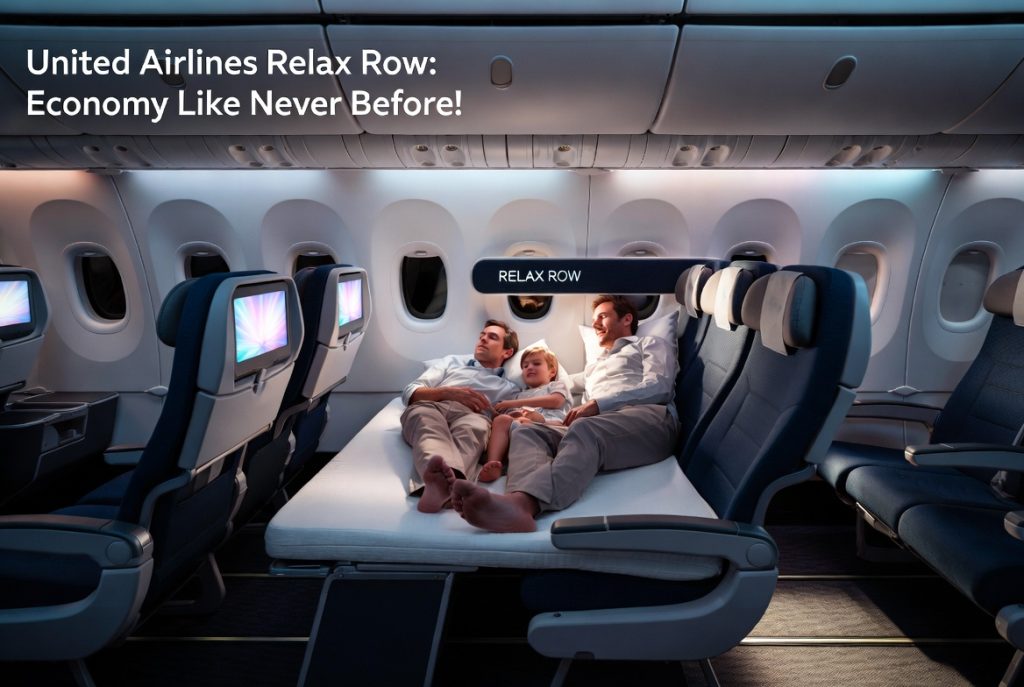
There is a moment on nearly every long-haul flight — usually somewhere over the mid-Atlantic or the vast expanse of the Pacific — when the limitations of economy class become impossible to ignore. Your legs ache from the constrained position. The passenger ahead has reclined fully, compressing your space by another few inches. Sleep feels theoretically possible but practically out of reach, your body stubbornly refusing to rest in a seat designed for sitting, not sleeping. You glance toward the drawn curtain separating economy from business class, where the fortunate few are stretching out on seats that fold fully flat.
United Airlines wants to change that calculation. The airline's newly revealed Relax Row promises exactly what its name suggests: genuine relaxation in a long-haul economy setting. Book three adjacent economy seats, pay the Relax Row supplement, and receive leg rests that fold up to fill the gap between seats and the row ahead, turning the trio into something approaching a flat surface — a sky bed, in the airline's parlance. It is not business class. But it may be the most meaningful step toward economy-class comfort that any U.S. airline has taken in a generation.
The announcement generated immediate attention among frequent flyers, aviation enthusiasts, and travel writers. And for good reason. The Relax Row is not a marginal upgrade — it is a rethinking of what economy class can offer on long international routes, particularly for families and couples who have long faced an uncomfortable binary choice: pay premium prices for business-class comfort, or spend twelve or more hours in the upright economy position.
In this article, we go beyond the announcement to examine every aspect of the Relax Row concept: what it includes, how it compares to United's broader cabin lineup and to international competitors, who it is designed for, what we know about pricing, and what it tells us about where airline product development is heading. By the end, you will have a thorough understanding of whether the Relax Row belongs in your travel plans when it arrives in 2027.
"The Relax Row is a philosophical statement as much as a product launch. United Airlines is asserting that the gap between economy and business class does not have to be as wide as the aviation industry has assumed for the past four decades."
| RELAX ROW: KEY FACTS AT A GLANCE |
| ✈️ Aircraft: Boeing 777 and Boeing 787 (long-haul international fleet) |
| 📅 Launch timeline: 2027 — specific routes to be announced closer to debut |
| 🪑 Configuration: Three adjacent economy seats converted via fold-up leg rests |
| 🛏️ Bedding: Mattress pad, full bedding set, two pillows; stuffed animals for children |
| 📺 Screens: Three 13-inch 4K OLED panels — one per seat position |
| 🔌 Power: 8 total sources — 2 AC wall plugs + 2 USB-C ports per seat (6 USB-C + 6 AC total) |
| 💰 Pricing: Unconfirmed; expected comparable to Economy Plus, below Premium Plus |
| 🌍 Closest competitor: Air New Zealand Economy Skycouch (~$499–$1,000, same aircraft types) |
| 🇺🇸 Market position: First product of its kind offered by a U.S. airline |
Section 1: Anatomy of the Relax Row — Every Feature Examined
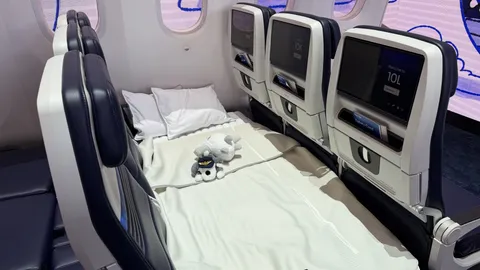
To understand what United Airlines is offering, think of the Relax Row as a product that operates in two distinct modes. In standard configuration it looks like any other economy row — three seats, three trays, three entertainment screens. The transformation happens when the leg rests are deployed. These purpose-built extensions fold up from the seat bases to fill the gap between the seats and the seat backs in front, creating a continuous surface: a sky bed wide enough for two adults or one adult with two young children sleeping comfortably across it.
Physical Dimensions and What 'Lie-Flat' Actually Means
The physical dimensions of the Relax Row are important for setting accurate expectations. Three economy seats placed side by side on a typical 777 or 787 configuration span approximately 160 to 180 centimeters in width. The length of the sleeping surface is constrained by seat pitch — the distance between rows — which in long-haul economy tends to run 31 to 33 inches. The Relax Row's sleeping area is therefore wider than a standard twin bed but shorter in length than a full business-class lie-flat seat, which typically measures 76 to 80 inches from head to foot.
United has navigated this dimension challenge thoughtfully. The product is called a Relax Row, not a 'lie-flat bed' in the business-class sense, and the positioning is deliberately about rest and comfort rather than full-length flat sleeping. That said, for children — who are both shorter and more flexible than adults — the Relax Row effectively does offer a genuine lie-flat surface. For adults over roughly 5'4" (163cm), the sleeping position will involve some bending at the knees, similar to curling up on a wide but not overlong couch. Uncomfortable? Not particularly. Identical to business class? Not quite.
The mattress pad United includes is critical to making this work. Economy seats have hard plastic surfaces, awkward transitions between adjacent seat cushions, and gaps at the seams between seats. A purpose-designed mattress pad unifies these surfaces and adds cushioning across the full width of the three-seat spread. The result is a sleeping surface that is genuinely comfortable for extended rest — not a luxury hotel experience, but meaningfully better than attempting to sleep upright.
Eight Power Ports: The Most Surprising Specification
Among the Relax Row's features, the power provision is arguably the most striking on paper — and the most immediately practical for the device-heavy traveler. Each of the three seats offers two standard AC wall outlets and two USB-C ports. Across three seats that totals six AC outlets and six USB-C ports for a single booking — eight sources of power in the parlance United uses in its marketing.
For context: a standard United economy seat typically provides one USB-A port and one AC outlet. United's flagship Polaris business class — the premium transatlantic and transpacific product — offers two USB-C ports, one wireless charging pad, and one AC outlet per passenger. The Relax Row, in terms of raw charging infrastructure, actually exceeds what Polaris provides to each individual passenger.
This matters because modern long-haul travel is extraordinarily device-intensive. A family of three might carry three smartphones, two tablets, a Nintendo Switch or similar handheld console, a pair of wireless headphones each, and a camera. A couple traveling for work might each need to charge a laptop in addition to personal devices. The chronic anxiety of watching battery indicators decline over a twelve-hour flight — knowing the single outlet is occupied and the next charging opportunity is the destination airport — is a pain point that millions of economy travelers encounter on every long-haul journey. The Relax Row makes this anxiety a thing of the past.
Three 4K OLED Screens
Each of the three seat positions in a Relax Row configuration is equipped with a dedicated 13-inch 4K OLED display — the same panel specification being rolled out across United's new elevated cabin interior. These represent a meaningful step up from the 1080p HD LCD screens that have been the economy class standard for the past decade or more.
The 4K resolution at 13 inches translates to a pixel density sharp enough that individual pixels are essentially invisible at normal viewing distances, giving movie content, maps, and interactive entertainment a clarity and crispness that is genuinely impressive at 35,000 feet. OLED technology adds further quality advantages: perfect blacks (individual pixels switch off completely rather than dimming), superior contrast ratios, and better viewing angles — all of which matter when you are watching a film in a dimmed long-haul cabin.
Three independent screens means three members of a Relax Row party can watch entirely different content simultaneously without compromise. Parents can watch a drama while children watch animated films. Solo travelers who book a full Relax Row have the luxury of choosing which screen to watch from, based on comfortable viewing angle. This is a quality-of-life detail that sounds minor but adds up meaningfully over a twelve-hour flight.
The Bedding and Comfort Package
United has assembled a comfort package that goes well beyond a thin blanket and a synthetic pillow. The full Relax Row bedding set includes the mattress pad, a blanket of the kind of meaningful weight and softness more typically associated with premium economy than standard economy, and two full pillows per booking. For family bookings with children, the addition of stuffed animals is a charming and psychologically astute detail — a reassuring, familiar object for young children in an unfamiliar high-altitude environment.
The overall effect of the bedding package is to bridge the gap between 'economy class that happens to be flat' and 'something that genuinely resembles a sleeping environment.' United clearly understands that the physical flatness of the surface is only part of what makes lie-flat business class so much more restful than economy. The softness, warmth, and psychological comfort of proper bedding contribute enormously. By including them in the Relax Row package, the airline is making a serious attempt to replicate not just the position but the experience of premium-class rest.
Practical Note: The mattress pad and bedding are provided at your seat when boarding begins. United flight attendants will assist with setup on request, similar to how business-class turndown service works on many carriers.
Section 2: Who Is the Relax Row Designed For?
United Airlines has identified three primary customer groups for the Relax Row: solo travelers seeking more personal space, couples wanting to travel together comfortably on long-haul routes, and families with children. Each has different needs and different reasons why standard economy fails them — and the Relax Row addresses each in distinct ways.
Families with Young Children: The Most Compelling Use Case
For families with young children, the challenges of long-haul economy are uniquely difficult. A child of four or five years old cannot sit upright for twelve hours. They need to move, stretch, and eventually sleep — preferably lying flat. Economy class provides none of these options. Parents spend entire long-haul flights performing contortions of distraction, bribery, and creative positioning, desperately trying to get overtired children to sleep in seats that were not designed for sleeping.
The Relax Row resolves this almost completely. With the leg rests deployed and the mattress pad in place, a parent with two young children has a surface wide enough for both children to lie flat side by side, with the parent able to recline alongside them or sit watching content on one of the three screens. Children who would typically spend much of a long-haul flight crying from tiredness and discomfort can instead sleep normally, as they would in a bed at home.
The economic arithmetic also works in families' favor. Three economy seats in a Relax Row configuration — at pricing that United suggests will be comparable to Economy Plus — is dramatically cheaper than three Premium Plus seats or a single business-class seat. For a family that previously faced a choice between standard economy misery and financially ruinous premium cabin upgrades, the Relax Row opens a third path: meaningfully more comfortable than economy, meaningfully cheaper than premium.
Couples: The Romantic and Practical Case
For couples traveling together on long international routes — whether for vacation, to visit family, or for a combination of work and leisure — the Relax Row offers advantages that are both romantic in the abstract and practical in the immediate. Long-haul travel is an inherently isolating experience even when undertaken with a partner. The narrow seats, the individual entertainment screens, and the general physical constraint of economy class mean that two people traveling together often have remarkably little interaction for the duration of a twelve-hour flight.
The Relax Row changes this dynamic. Two adults sharing a three-seat Relax Row have the width to lie alongside each other — to sleep as they might at home rather than in the rigid adjacency of standard economy seating. The third seat provides both additional width for comfort and a surface for belongings, bags, and personal items that would otherwise clog overhead bins and under-seat spaces. The overall effect is of a shared personal space within the aircraft, rather than the individual isolation of standard economy.
Solo Travelers: The Premium Space Upgrade
For a solo traveler booking a Relax Row, the product is essentially a personal aircraft territory — three seats and all the associated space, screens, and power for one person. This is an unusual and potentially transformative experience in an economy cabin. The ability to spread out, to have separate surfaces for a laptop, a book, and personal items, to have power ports to spare, and to sleep lying flat on a surface wide enough that rolling over does not mean falling off — all of these create an experience that bears almost no resemblance to standard economy.
The obvious counterargument is cost: booking three seats as a solo traveler, even at Relax Row pricing comparable to Economy Plus, means paying three times the base fare plus the Relax Row supplement. For most routes and most travelers, this will not make financial sense. But for premium economy or business-class-inclined travelers who want to manage costs on a specific route, the Relax Row may prove a genuinely compelling option.
Section 3: How the Relax Row Fits into United's Full Cabin Lineup
The Relax Row does not exist in isolation — it is one element of a broader cabin renovation that United Airlines has been pursuing under the banner of its 'Elevated' product strategy. Understanding where the Relax Row sits within this lineup helps clarify both its positioning and its value proposition.
| Cabin Class | Seat Type | Screens | Power | Flat Bed? | Notable Perks |
| Polaris Studio | Private pod / suite | Large OLED | 2x USB-C, wireless charging, AC | Full lie-flat | Maximum privacy, premium dining |
| Polaris Business | Lie-flat seat | Large OLED | 2x USB-C, wireless charging, AC | Full lie-flat | Fully flat, premium meal service |
| Premium Plus | Wider recliner | HD screen | USB-C + AC | No | Extra recline, meal upgrade |
| Economy Plus | Standard + extra legroom | HD screen | USB-A + AC | No | 2–5" extra legroom |
| Relax Row | 3-seat sky bed | 3x 13" 4K OLED | 6x USB-C + 6x AC (8 total) | Near lie-flat | Mattress pad, bedding, family amenities |
| Standard Economy | Standard seat | HD screen | USB-A + AC | No | Core offering |
What this comparison makes clear is that the Relax Row carves out a genuinely novel position in United's lineup. It is not an upgraded version of Economy Plus, even though its pricing may be similar. It is a categorically different product — one that combines the communal, multi-seat character of booking a row with amenities (bedding, mattress, 4K OLED screens, extreme power provision) that in some respects exceed what individual premium cabin seats offer.
The Polaris Studio and Polaris business class seats remain superior in key respects: they offer full, unqualified lie-flat length; private or semi-private suite configurations; premium meal and beverage service; dedicated lounge access; and the social cache of business-class travel. These are not trivial advantages, and the Relax Row does not replace them for passengers who value those elements.
But for passengers who prioritize rest and comfort above premium service and social positioning — and who are traveling with family members or a partner — the Relax Row's value proposition is clear. You get flat sleeping for two (or flat sleeping for children plus reclined rest for one adult), more screens than any other United cabin configuration, more power than business class, and a dedicated bedding package, at a price point that sits well below premium cabin fares.
Section 4: The Competitive Landscape — Air New Zealand's Skycouch and Beyond
United Airlines has been careful in its framing of the Relax Row not to claim that it invented the concept of economy sky beds — because it did not. Air New Zealand has been operating its Economy Skycouch for over a decade on long-haul routes, and the concept has proved durable and popular enough to survive through multiple fleet generations and cabin refreshes.
Air New Zealand's Economy Skycouch: The Blueprint
The Air New Zealand Economy Skycouch works on essentially the same principle as the Relax Row: passengers book a row of economy seats (typically three), and fold-up foot rests extend from the base of the seats to create a flat surface. Air New Zealand offers the Skycouch on Boeing 777 and 787 aircraft — the same platforms United has chosen for the Relax Row — which reflects both the prevalence of these wide-body aircraft on long-haul routes and the fact that their seat configurations lend themselves to the three-seat row booking model.
Based on searches conducted at the time of publication, Air New Zealand's Skycouch pricing runs between approximately $499 and $1,000 depending on route, season, and demand. The Skycouch has built a strong following among New Zealand and Australian travelers on Pacific routes, and Air New Zealand has consistently cited it as one of its most popular and differentiated products in the economy and economy-adjacent segment.
The similarities between Skycouch and Relax Row are substantial: same aircraft type, same three-seat configuration, same fold-up foot rest mechanism, same target customer groups (families, couples, solo travelers seeking extra space). The differences come in the details. United's offering adds 4K OLED screens, the dramatically expanded power provision (eight sources versus Skycouch's more standard economy offering), and a mattress pad and full bedding set that goes beyond what Skycouch typically provides.
Why This Matters for U.S. Aviation
The significance of United's Relax Row is amplified by the fact that it is, as United has positioned it, the first product of its kind offered by a U.S. carrier. American airlines have generally been slower than their international counterparts to innovate in economy class, focusing their product investment primarily on business and first-class cabins where the revenue per seat is highest. The decision by United — the world's largest airline by number of destinations served — to invest in an economy-class sleep product for long-haul routes signals a potential shift in that philosophy.
If the Relax Row proves successful, it will almost certainly prompt competitive responses from American Airlines and Delta Air Lines, both of which operate extensive long-haul networks on 777 and 787 aircraft. The aviation industry is intensely competitive in the premium economy and economy-plus segments, and a successful United economy sleep product is exactly the kind of innovation that prompts imitation. This is good news for economy class travelers broadly: competition in cabin product innovation generally means better options for passengers across the board.
Section 5: Pricing, Booking, and What We Do Not Yet Know
United Airlines has been deliberately cautious about sharing detailed pricing information for the Relax Row, and this is understandable. Dynamic airline pricing means that the 'price' of any seat product is not a single number but a range that varies by route, season, demand, booking window, and frequently individual traveler profile. What United has shared is a positioning statement: Relax Row pricing will be 'comparable to Economy Plus' and significantly below Premium Plus and Polaris.
What 'Economy Plus Comparable' Actually Means
Economy Plus on United Airlines is the airline's extra-legroom economy product, adding two to five inches of additional pitch compared to standard economy and generally providing access to earlier boarding and overhead bin space. Economy Plus upgrades typically cost between $30 and $200 per flight depending on route and booking timing, applied per seat. For a Relax Row booking of three seats, this implies a Relax Row supplement of somewhere in the range of $100 to $600 per booking (not per seat), in addition to the cost of three economy base fares.
If this pricing estimate proves accurate, the Relax Row represents remarkable value for families with two children. Booking two adult economy fares plus two child fares with a Relax Row supplement of $300 to $500 might cost $2,000 to $3,500 on a major transpacific route — compared to $8,000 to $15,000 for four Premium Plus seats, or $20,000 or more for two Polaris business class seats. For the family that currently has no affordable option for comfortable long-haul travel, the Relax Row is transformative.
What We Are Still Waiting to Learn
Several critical details remain unconfirmed at the time of publication. United has not announced which specific routes will receive Relax Row-equipped aircraft first, how many Relax Rows will be installed per aircraft, how the booking system will work (whether Relax Rows will be bookable as a single unit or require separate seat selection plus a supplement flag), or what the cancellation and change policy will be for Relax Row bookings.
The question of per-aircraft availability is particularly important. If each 777 or 787 has only two or three Relax Row configurations, they will sell out quickly on popular routes — potentially limiting the product's availability to frequent flyers, loyalty program members, or those willing to book very far in advance. United's history with premium economy products suggests the airline is aware of this challenge and will manage inventory accordingly, but the specifics will matter greatly.
Booking Advice: Set a fare alert for United long-haul routes you plan to travel in late 2027 and 2028. Relax Row inventory is likely to be limited initially, and early bookers will have the best selection.
Section 6: The Broader Context — United's Elevated Cabin Strategy
The Relax Row did not emerge in isolation. It is part of a much broader investment United Airlines has been making in its cabin product across all classes of service. The airline's 'Elevated' cabin strategy — originally teased in 2025 and now being rolled out across its fleet — encompasses redesigned Polaris Studio private suites, next-generation Polaris business class seats, an updated Premium Plus product, and the comprehensive economy and Economy Plus refresh.
Next-Generation Polaris Studio and Polaris
United's Polaris Studio represents the airline's answer to the trend toward private suites in business class that Singapore Airlines, Qatar Airways, and Emirates pioneered. The Studio offers the most enclosed, private travel environment available on a U.S. carrier — effectively a mini-room within the aircraft, with a closing door, a large OLED entertainment screen, dedicated storage, and a full lie-flat surface. For premium travelers, it is a significant step toward the ultra-luxury cabin experiences available on some international carriers.
The standard Polaris business class seats — redesigned alongside the Studio — represent an upgrade to what was already one of the better U.S. carrier business products. The new seats offer improved lie-flat ergonomics, updated entertainment screens, and the enhanced power provision (including wireless charging) that is becoming a baseline expectation for premium cabin travelers.
Starlink Wi-Fi: The Connectivity Revolution Running in Parallel
United's cabin product announcements have been accompanied by a parallel connectivity story that is equally significant for the passenger experience: the rollout of Starlink satellite internet across United's fleet. Over 340 United aircraft were already flying with Starlink Wi-Fi at the time of the Relax Row announcement, with the airline targeting fleet-wide deployment.
Starlink represents a qualitative leap in in-flight connectivity. Traditional in-flight Wi-Fi, delivered via geostationary satellites, has historically offered speeds that are adequate for email and light browsing but inadequate for video streaming, video calls, or any bandwidth-intensive application. Starlink's low-earth orbit constellation delivers speeds that are meaningfully faster — sufficient for HD video streaming, video calls, and the kind of productivity work that business travelers increasingly need to conduct in flight.
The combination of Relax Row comfort with Starlink connectivity creates an interesting proposition: a long-haul economy experience where passengers can both rest comfortably and, when they are not sleeping, work or entertain themselves with internet connectivity that matches what they have on the ground. For remote workers, digital nomads, and business travelers who book economy for cost reasons, this combination may prove particularly compelling.
The Competitive Implications
United's Elevated strategy is clearly designed to address the competitive pressure the airline faces from both domestic competitors — American and Delta — and international carriers on long-haul routes. On routes between the U.S. and Europe, United competes directly with Lufthansa, British Airways, Air France, and others, all of which have been investing heavily in their premium and economy products. On Pacific routes, the competition includes Singapore Airlines, Cathay Pacific, and ANA — carriers with international reputations for cabin excellence.
By investing in the full spectrum of cabin classes — from Polaris Studio at the top through the novel Relax Row in economy — United is signaling that it intends to compete on product quality across all passenger segments, not just in premium. This is a more ambitious and more expensive strategy than simply upgrading business class while leaving economy largely unchanged. But if executed well, it could meaningfully differentiate United from competitors who have been slower to invest in economy class innovation.
Section 7: Practical Travel Tips for the Relax Row Era
The Relax Row is still a couple of years away from being available to book, but forward-planning travelers can start thinking now about how to incorporate it into their long-haul travel strategy. Here are the key practical considerations.
Which Routes to Watch
United's long-haul network on 777 and 787 aircraft covers the major transpacific routes (Los Angeles, San Francisco, Chicago, Newark to Tokyo, Shanghai, Singapore, Sydney, Auckland, Hong Kong, Seoul) and the major transatlantic routes (Newark, Washington Dulles, Chicago, Houston to London, Frankfurt, Amsterdam, Zurich, Rome, Madrid, and others). Any of these routes is a candidate for Relax Row deployment, though United has not confirmed which will be first.
Routes where the Relax Row would be most valuable are those with the longest flight times — 12-plus hours where sleep is not just desirable but genuinely necessary for arriving in reasonable condition. The Tokyo, Singapore, Sydney, and Auckland routes from the U.S. West Coast are obvious candidates. So are overnight transatlantic routes from the U.S. East Coast to Europe.
Packing Strategies for Relax Row Travelers
The Relax Row fundamentally changes the calculus of what to bring onto the aircraft, because the sleeping surface changes what you need for comfort. If you are booking a Relax Row specifically to sleep, you will likely find that the provided mattress pad and bedding are sufficient without supplemental comfort items. This potentially means leaving behind the travel pillow and compression socks that economy class sleep attempts typically require.
The eight-port power infrastructure means you can safely bring every device you own without worrying about charging prioritization. Bring the laptop, the tablet, the Nintendo Switch, the camera battery — the power is there. What you do not need to bring are portable battery packs, which add weight and have become increasingly regulated by airline policies.
Maximizing the Three-Screen Setup
Three separate 4K OLED screens open up content viewing options that a single-seat setup cannot match. Families might designate one screen as the 'children's screen' and let kids select content from the United app autonomously, freeing adults to watch their own choices. Solo travelers might use one screen for a film, one for the moving map, and one for content browsing — tripling the functional surface area for in-flight entertainment.
Expert Tip: Download United's entertainment app before boarding to access content offline and browse the full catalog at home before your flight — arriving with a personal watchlist makes the three-screen setup even more enjoyable.
Health and Wellbeing on a Relax Row Flight
One underappreciated aspect of the Relax Row is its potential positive impact on physical wellbeing during long-haul travel. Economy class sleep is associated with poor posture, muscular tension, and the kind of stiff, unrested feeling on arrival that takes a day or more to shake off. Lying genuinely flat — or close to flat — significantly reduces these effects. Combined with the ability to change position more freely on the wider surface, the Relax Row may meaningfully reduce the physical toll of long-haul travel.
Deep vein thrombosis (DVT) risk, a concern for any long-haul economy traveler, is also reduced by the ability to move and reposition more freely. The Relax Row's leg rest design allows for leg extension and positional changes that are simply not possible in a standard economy seat. Travelers who are medically advised to move frequently during long flights will find the Relax Row a meaningfully safer and more comfortable environment.
Conclusion: A First in U.S. Aviation — and a Sign of Things to Come
The United Airlines Relax Row is one of the most interesting economy class innovations the U.S. aviation industry has seen in a long time. It is not a revolutionary concept — Air New Zealand has been doing something similar for years. But bringing a lie-flat economy sleep product to U.S. long-haul travel for the first time, with a specification sheet that includes 4K OLED screens and more power ports than business class, marks a meaningful shift in what economy travelers on U.S. carriers can expect.
The value proposition is strongest for families with young children — the group for whom standard long-haul economy is most acutely inadequate and for whom the cost of genuine alternatives (premium economy, business class) is most prohibitive. For these travelers, the Relax Row potentially transforms what has been one of travel's most dreaded experiences — the long-haul overnight economy flight with small children — into something genuinely manageable and perhaps even enjoyable.
For couples and solo travelers, the case is compelling but more financially nuanced. Paying for three seats as two people, or three seats as one person, adds up. The total cost will need to sit at the right price point relative to premium economy alternatives for the Relax Row to be the obvious choice rather than merely an interesting one. United's claim that pricing will be 'comparable to Economy Plus' is encouraging, but the details will determine whether the promise holds in practice.
What is not in doubt is the broader significance of the announcement. United Airlines is the largest U.S. carrier by many measures, and its product decisions carry outsized influence on the industry. When United invests in economy-class innovation, its competitors pay attention. If the Relax Row succeeds — and the track record of Air New Zealand's similar product suggests it will — the pressure on American and Delta to respond will be significant.
We are a year away from launch. Much remains unconfirmed: the specific routes, the per-aircraft Relax Row count, the exact pricing structure, and the full details of how the bedding and service experience will work at scale across United's network. These details matter, and we will update our coverage as they emerge.
But for now, the Relax Row represents the kind of product announcement that makes long-haul economy travelers — particularly those who are parents, who are couples, or who have simply been worn down by too many upright overnight crossings — look at their 2027 and 2028 travel plans with a new sense of possibility. That is no small thing.
FAQ – United Airlines Relax Row (Economy Sky Bed Concept)
1. What is United Airlines Relax Row?
Relax Row is a new economy-class upgrade that allows passengers to book three adjacent seats and convert them into a flat resting surface using fold-up leg rests and a mattress pad.
2. When will Relax Row be available?
United Airlines plans to launch Relax Row in 2027 on long-haul international flights.
3. Which aircraft will feature Relax Row?
The product will be available on Boeing 777 and Boeing 787 aircraft used for long-haul routes.
4. Is Relax Row the same as business class?
No. While it offers a near lie-flat sleeping surface, it does not provide the full length, privacy, or premium services of business class.
5. How does Relax Row work?
Passengers book three economy seats together. A fold-up leg rest fills the gap between rows, creating a wider, flatter surface suitable for resting or sleeping.
6. Who is Relax Row designed for?
It is ideal for:
- Families with young children
- Couples traveling together
- Solo travelers wanting extra space
7. How comfortable is the sleeping surface?
It is significantly more comfortable than standard economy, especially with the included mattress pad and bedding, though shorter than a full business-class bed.
8. Will bedding be included?
Yes, passengers receive a mattress pad, blanket, pillows, and additional comfort items (including toys for children).
9. How many screens are included?
Each Relax Row includes three 13-inch 4K OLED screens, one for each seat position.
10. What about charging and power?
Relax Row offers extensive power options, including multiple USB-C ports and AC outlets, making it ideal for travelers with multiple devices.
11. How much will Relax Row cost?
Pricing is not finalized, but it is expected to be similar to Economy Plus upgrades, making it more affordable than Premium Plus or business class.
12. How does Relax Row compare to competitors?
It is similar to the Economy Skycouch by Air New Zealand, but adds features like 4K OLED screens and enhanced power options.
13. Can one person book a Relax Row?
Yes, but it requires purchasing all three seats, which may be costly for solo travelers.
14. Is Relax Row good for long-haul flights?
Yes, it is specifically designed for long flights (10–15+ hours) where sleeping comfort is important.
15. Will Relax Row be available on all routes?
No, availability will depend on aircraft and routes, which will be announced closer to launch.
16. Does Relax Row improve travel health and comfort?
Yes, the ability to lie flat or stretch out can reduce fatigue, improve sleep quality, and lower discomfort during long flights.
17. Can children fully lie flat?
Yes, children can typically lie fully flat, making it especially useful for families.
18. Is Relax Row worth it?
For many travelers—especially families—it offers a strong balance between comfort and cost, sitting between standard economy and premium cabins.
Leave a Reply